

By the time most couples start reading about Gottman therapy for couples, they’ve had the same argument so many times they could recite it. The topic changes: whose turn it was to call about the AC, how long the in-laws are staying, why Saturday got planned without asking. The ending doesn’t. One of you goes quiet, the other gets louder, and you both go to bed feeling misunderstood.
The Gottman method is built around that exact pattern. Psychologists John and Julie Gottman spent years studying how couples talk to each other, then turned what they saw into a way of doing couples therapy. This guide covers the main ideas, what sessions tend to look like, who it suits, who may need a different starting point and what it can’t promise. For everyday habits, see the post on building a healthy couple relationship.
Buxani Counseling Care is a mental health clinic in Miami that offers couples therapy in person and through telehealth in Florida. Its couples therapy page says its therapists may incorporate principles from the Gottman Method when appropriate, and the clinic has a separate page on Gottman therapy. Nothing here can tell you what’s going on in your relationship, and it doesn’t replace advice from a licensed professional.
What Is Gottman Therapy for Couples?
Gottman therapy for couples is a research-based way of doing couples counseling, developed by psychologists John and Julie Gottman. It focuses on three things: the friendship between partners, how they handle conflict, and the meaning they share.
John Gottman is a professor emeritus of psychology at the University of Washington, and Julie Schwartz Gottman is a clinical psychologist. Their best-known work includes a long study of newlywed couples who spent time in a lab set up like an apartment and were followed for years afterward, as John Gottman described in a 2024 American Psychological Association podcast.
Their theory of what holds a lasting relationship together is called the Sound Relationship House. Picture a house where the lower floors, built on friendship, hold up the ones above. As the Gottmans describe it, the parts are:
- Build love maps: really knowing your partner’s inner world
- Share fondness and admiration
- Turn toward each other instead of away
- The positive perspective: a generally warm view of each other
- Manage conflict
- Make life dreams come true: supporting what matters to each of you
- Create shared meaning
- Trust and commitment, the two walls that hold the house up
Buxani Counseling Care’s Gottman therapy page lists seven principles instead: building love maps, nurturing fondness and admiration, turning toward instead of away, accepting influence (taking your partner’s view seriously enough that it can change what you do), solving solvable problems, overcoming gridlock and creating shared meaning. The ideas overlap, and the rest of this guide follows them.
Who created Gottman therapy?
Psychologists John Gottman and Julie Schwartz Gottman. John Gottman is a professor emeritus of psychology at the University of Washington, and Julie Schwartz Gottman is a clinical psychologist. Their approach grew out of research on how couples interact.
Is Gottman therapy only for married couples?
No. It’s used with couples who are dating, living together or married, and published research has included gay and lesbian couples. What matters most is that both partners want to work on the relationship.
Is Gottman therapy the same as couples counseling?
Not exactly. Couples counseling is the broad term, and the Gottman method is one approach inside it. Many therapists draw on more than one method, so it’s fair to ask which ideas they use and why.
Does Buxani Counseling Care use the Gottman Method with couples?
Its couples therapy page says its therapists may incorporate principles from the Gottman Method when appropriate. The clinic also has a Gottman therapy page that describes a five-step process, which is covered further down.
How Does the Gottman Method Work in Everyday Life?
The method strengthens what’s already good between two people and changes the habits that wear it down. In daily life that means a few skills: knowing each other’s worlds, noticing small moments, handling conflict without hurting each other, and building something you both care about.
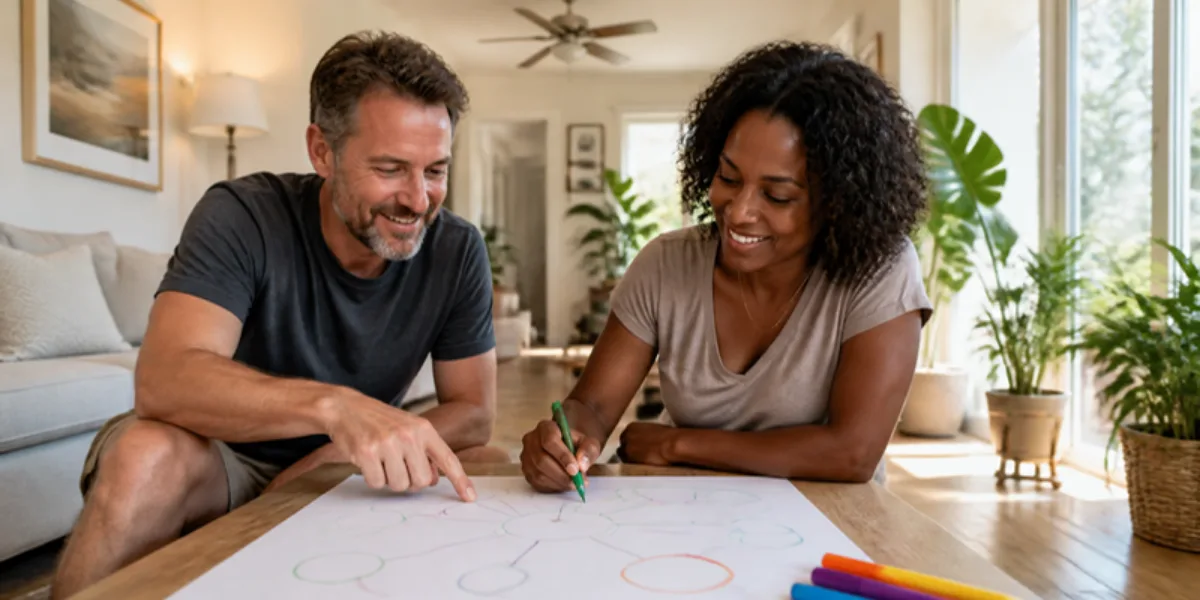
Love maps: knowing your partner’s world
A love map is the Gottmans’ name for what you know about your partner’s inner life: worries, hopes, friends, history, favorite things. The Gottman Institute compares the first version to a pencil sketch that keeps filling in, because people keep changing.
Do you know which coworker is wearing your partner down this month? What they’re dreading about the holidays? The habit is simple: ask open questions, listen to the whole answer and remember it. In therapy it can become a guided exercise, and Buxani Counseling Care’s Gottman therapy page lists relationship mapping exercises among its techniques.
Fondness and admiration
It sounds soft, but it’s practical: noticing what you respect in your partner and saying it out loud. “I saw how patient you were with your dad on that call. Thank you.” On the same APA podcast, John Gottman said couples who did well averaged about five positive moments for every negative one during conflict, while couples whose relationships later broke down averaged fewer than one. That’s what researchers observed, not a quota to count.
Turning toward bids
A bid is a small attempt to get your partner’s attention, interest, humor or support. “Look at the iguana on the fence.” A sigh when they come through the door. Your partner can turn toward the bid (look up, answer, smile), turn away (keep scrolling) or turn against it (“Not now”).
John Gottman also reported there that in the Gottmans’ newlywed study, couples who stayed married turned toward their partner’s bids an average of 86 percent of the time, compared with 33 percent for couples who later divorced. Those are group averages from one research team, not a score for your relationship. A therapist may point out a missed bid as it happens and help both partners start noticing them.

How do you build a love map?
Ask open questions, listen to the whole answer and remember it. “What’s weighing on you at work this month?” or “What are you looking forward to this year?” get further than “How was your day?” Keep at it, since the map needs updating as your partner changes.
What is a bid for connection?
Any small attempt to get your partner’s attention, affection, humor or support, from “Come look at this sunset” to a sigh when they walk in. Answering with interest is called turning toward.
What is the Gottman 5 to 1 ratio?
It’s a research finding John Gottman described on an American Psychological Association podcast: couples who did well averaged about five positive interactions for every negative one during a disagreement, while couples whose relationships later broke down averaged fewer than one positive for each negative. It describes what the researchers saw, not a quota to keep track of, and it can’t tell you how your own relationship is doing.
Does Buxani Counseling Care use exercises to build closeness?
Its Gottman therapy page lists relationship mapping exercises, emotional connection exercises and appreciation and gratitude practices among the techniques therapists may use, along with active listening. Which ones fit depends on the couple’s goals.
The Four Horsemen and Their Antidotes
The Four Horsemen is the Gottmans’ name for four habits that can turn a disagreement ugly: criticism, contempt, defensiveness and stonewalling. Each has an antidote, a different habit to reach for instead.
1Criticism: try a softer start
Criticism attacks who your partner is instead of raising one problem. “You never help with anything” is criticism. “I felt swamped by the dishes tonight, can we split them differently?” is a complaint. The antidote is a gentler start: describe what happened, say how you feel and ask for what you need, without blame.
2Contempt: build appreciation
Contempt is mockery, sarcasm, name-calling or eye-rolling that treats your partner as beneath you. John Gottman has said contempt was the best predictor of breakup in their research. The antidote is a habit of appreciation and respect: regularly saying what you value, and meaning it.
3Defensiveness: own a piece of it
Defensiveness is the reflex to protect yourself with excuses, a counter-complaint or “It’s not my fault.” It makes sense, and it usually pours fuel on the fire. The antidote is owning even a small part: “You’re right, I said I’d call about the AC, and I forgot.”
4Stonewalling: take a break
Stonewalling means shutting down: going silent, staring at the phone, leaving the room. It often isn’t a punishment. The Gottmans describe it as what happens when someone feels flooded, overwhelmed enough that the conversation stops getting through. The antidote is a break. Say you need one, do something calming, and come back to the talk.

Repair Attempts: How Couples Cool a Fight Down
A repair attempt is any move, spoken or not, that keeps a disagreement from spiraling. John Gottman describes it as any verbal or non-verbal action that prevents negativity from escalating during conflict. It might be an apology, a bit of gentle humor, “Can we start over?”, “I’m getting overwhelmed, give me a minute” or a hand on a shoulder. Making a repair doesn’t mean you’ve lost. It does have to be noticed, though: if your partner is too angry to hear the joke, it bounces off.
Managing Conflict Versus Solving It
Some problems have a fix: who handles Thursday pickup, how the hurricane shutters go up, how much to spend on a trip. Others never fully go away because they come from real differences in personality or values: one partner saves and the other spends, one needs weekends with family and the other needs quiet. Julie Schwartz Gottman said on the APA podcast that 69 percent of couples’ problems are perpetual, meaning they never go away.
So the method doesn’t aim to end every argument. It aims to help couples talk about the stuck ones without hurting each other and to find what’s underneath. John Gottman described asking deepening questions about the values and dreams behind a recurring issue. A fight about money might really be about safety for one partner and freedom for the other. Buxani Counseling Care’s seven principles name this split directly: solving solvable problems, and overcoming gridlock.
A good fight ends with both people still on the same team.
Shared meaning
The top floor of the house is shared meaning: the rituals, roles, goals and values that make two people a team. Sunday lunch at the grandparents’, how you spend Noche Buena or Thanksgiving, what “home” means. Partners don’t need identical dreams. They need to know what matters to each other and make room for it.
Which of the Four Horsemen does the most harm?
John Gottman has said contempt was the best predictor of breakup in the Gottmans’ research. That doesn’t make the other three harmless, and one eye-roll doesn’t doom a relationship. It’s the pattern over time that counts.
What does flooding mean in a relationship?
Flooding is the Gottmans’ word for feeling so overwhelmed in an argument that your body goes on alarm and you can’t take in what your partner is saying. A pounding heart, a tight chest and going blank are common signs. The usual advice is to ask for a break, calm down on your own and come back.
Does Gottman therapy teach couples to stop arguing?
No. Disagreement is normal, and many problems never fully go away. The aim is to talk about them without contempt, criticism or shutting down, and to repair when a talk goes sideways.
Does Buxani Counseling Care help couples who argue a lot?
Its Gottman therapy page lists frequent arguments, difficulty resolving conflict and ongoing resentment among the reasons couples seek help. It names conflict management and relationship repair as areas sessions may focus on.
What to Expect From Gottman Therapy for Couples
Gottman-style couples therapy usually starts with an assessment, moves into building skills in the areas above, and includes practice between sessions. The exact format depends on the therapist and the couple.
In the method as its developers describe it, the assessment can include time with both partners together, time with each person alone and questionnaires, followed by feedback about the couple’s strengths and trouble spots. Then the therapist and the couple decide on goals and how often to meet.
Buxani Counseling Care’s Gottman therapy page describes its own process in five steps:
1Initial assessment
Understanding relationship concerns, communication patterns, emotional needs and therapy goals.
2Relationship evaluation
Identifying strengths, recurring conflict patterns, emotional disconnects and areas for growth.
3Learning Gottman skills
Techniques aimed at communication, emotional connection, trust and conflict management.
4Applying new tools
Practicing skills and exercises in sessions and between them.
5Long-term growth
The stated goal is lasting habits, stronger bonds and relationship satisfaction.
The page calls a session a structured, supportive space where couples can discuss concerns openly, personalized to the couple’s goals. It also mentions worksheets for practice outside sessions, so expect some homework-style work, which could be as simple as asking each other one open question a day or trying a softer start the next time something bugs you.

For the basics of any couples counseling, the post on how couples counseling works is a good start, and therapy activities for couples has more exercises to try.
Who Gottman Therapy Suits, and Who It May Not
It suits many couples, from those stuck in the same fight to those who simply want to stay close. It isn’t the right first step when safety is a concern.
Buxani Counseling Care’s Gottman therapy page lists signs a couple might benefit:
- frequent arguments, or trouble resolving conflict
- communication breakdowns and trust concerns
- emotional distance, or feeling disconnected even when you’re together
- intimacy concerns and ongoing resentment
- stress that spills into family life, including parenting
The page also says it can help couples who want to strengthen a relationship that’s already healthy, and the couples therapy page says therapy can be beneficial at any stage. You don’t have to be in crisis.
The method needs two people willing to take part. If only one partner is ready, individual therapy is a reasonable first step. It also isn’t the only approach to couples therapy, and a different method may suit you better.
When safety comes first
If a partner is controlling, threatening or violent, safety comes first, and couples counseling is not the right first step. Skills like a softer start can’t fix abuse, and sitting in a room with someone you fear isn’t safe. The National Domestic Violence Hotline is free, confidential and open 24 hours a day at 1-800-799-7233, and you can text START to 88788. If someone is in danger right now, call 911. The hotline’s website notes that internet use can be monitored, so if that’s a worry, calling is the safer choice.
The consultation form on Buxani Counseling Care’s therapy for couples in Miami page includes this question: whether either partner has struck, physically restrained, used violence against or injured the other.
How long does Gottman therapy take?
It varies. The therapist and the couple decide together how often to meet and for how long, based on goals and what’s going on in the relationship. Be wary of anyone who promises a fixed timeline or result.
Can Gottman therapy work if only one partner wants to go?
It’s built for two people working together, so it’s hard to do with one. If only one of you is ready, individual therapy can still help you sort out your thoughts and plan how to raise it. Pushing an unwilling partner to attend usually isn’t a good start.
Is Gottman therapy safe if my partner is controlling or violent?
Not as a first step. When a partner is controlling, threatening or violent, safety comes first, and couples counseling isn’t the right place to start. The National Domestic Violence Hotline is free, confidential and open around the clock at 1-800-799-7233. In an emergency, call 911.
How does Gottman therapy begin at Buxani Counseling Care?
According to its Gottman therapy page, it begins with an initial assessment of relationship concerns, communication patterns, emotional needs and therapy goals. A relationship evaluation follows, looking at strengths, recurring conflict patterns and areas for growth.
What Gottman Therapy Can’t Promise
No couples therapy can promise to save a relationship, and this one doesn’t either. Some couples find the skills help. Some decide, after working on things, that they want to part ways. Both are real outcomes.
The evidence is encouraging but modest. A small study in the Iranian Journal of Psychiatry found that couples who received Gottman couple therapy improved in marital adjustment and intimacy compared with a control group, and the gains held at follow-up. Small studies like this are early signals, not proof, and some research has involved people connected to the method, so larger independent studies would say more. The skills also depend on both partners keeping at them. As John Gottman put it, the techniques don’t work without trust and commitment.
Couples Therapy in Miami at Buxani Counseling Care
Buxani Counseling Care is a mental health clinic at 9700 S Dixie Hwy #880, Miami, FL 33156. Its licensed therapists work with individuals, children, teens, couples and families, in person in Miami and through telehealth in Florida. The clinic’s couples pages list concerns couples bring, such as communication problems, trust, jealousy, emotional distance, parenting disagreements and premarital questions, and name areas including Coral Gables, Kendall, Brickell and Doral among those it serves.
Gottman-informed work is one of the approaches mentioned there, used when appropriate. To see whether it fits, read the Gottman therapy page, or request a therapy appointment and say what’s been going on.
Final Takeaway
The Gottman method is a structured way to build friendship, handle conflict and share meaning, using ideas from decades of work by John and Julie Gottman. The habits at its center are small: learn each other’s worlds, notice the little bids, soften the start of a hard talk, take a break when you’re flooded, and repair when you can.
It isn’t a promise, and it isn’t for every situation. It needs two willing partners, and it doesn’t replace safety when someone is afraid. Used well, it gives a couple words and habits for the moments that used to end in a slammed cabinet or a silent drive home.
The fight about the AC call was never really about the AC. How you have it is the part you can change.
Frequently Asked Questions About Gottman Therapy for Couples
Does Gottman therapy work?
Some published studies report better marital adjustment and intimacy after Gottman therapy, but they’re small and some were run by people connected to the method. That makes the evidence encouraging, not settled. Results vary from couple to couple, and nobody can promise one.
Can Gottman therapy help after infidelity?
Therapists do use it for affair recovery, and a small pilot trial reported that the Gottman approach helped couples recovering from an affair more than other approaches did. A pilot trial is an early signal, though, and rebuilding trust takes time and effort from both partners.
Is Gottman therapy a good fit for same-sex couples?
The method was developed for couples in general, and published research has looked at how it works with gay and lesbian couples. Whatever approach you choose, ask the therapist directly how they work with couples like you.
How is Gottman therapy different from other couples therapy?
It rests on research about how couples interact and it’s practical: specific skills such as a softer start and repair attempts, plus practice between sessions. Other approaches start from different ideas, such as attachment or emotion, and many therapists blend several.
Do couples have to be in crisis to try Gottman therapy?
No. Some couples go before a wedding or a big move to practice talking about hard things, and others wait until things feel stuck. Asking for help early isn’t overreacting.
What can couples try at home before starting therapy?
Pick one habit. Start a hard talk with how you feel instead of what your partner did wrong, thank them for one specific thing a day, or ask one open question about their week. The post on couple relationship tips has more ideas, and if the same fight keeps coming back, a counselor can help.
Can couples do Gottman-style therapy online through Buxani Counseling Care?
The clinic’s couples pages say couples can attend in person at the Miami office or through secure telehealth. The telehealth therapy page has details for Florida.
How do couples book a first appointment at Buxani Counseling Care?
The website has a therapy appointment page with a request form, and the couples therapy page has a consultation form. Questions about cost or coverage are best answered by contacting the clinic directly.



Written and reviewed by a licensed mental health therapist.
