
If you have been asked to complete a psychological evaluation, you may wonder what actually happens during the process. Will you have to answer hundreds of questions? Are there right or wrong answers? How long does it take? What will the psychologist learn from the results?
Understanding what happens during a psychological evaluation can make the process feel much more comfortable and predictable.
A psychological evaluation is a structured process used to better understand a person’s thinking, emotions, behavior, cognitive abilities, learning patterns, and everyday functioning. Depending on the purpose of the evaluation, a psychologist may use interviews, standardized tests, questionnaires, observations, records, and information from parents, teachers, or other relevant people.
The exact process is different for every person because psychological assessments are selected according to the individual’s concerns, history, age, and the questions the evaluation needs to answer.

What Is a Psychological Evaluation?
A psychological evaluation is a comprehensive assessment conducted by a qualified mental health professional to better understand specific psychological, cognitive, emotional, behavioral, developmental, or learning concerns.
Rather than relying on one test, psychologists typically combine information from multiple sources. This may include a clinical interview, standardized psychological tests, questionnaires, behavioral observations, and relevant records.
The purpose is to develop a clearer picture of an individual’s strengths, challenges, and patterns of functioning. Psychological testing can also help psychologists make diagnostic decisions and develop appropriate recommendations or treatment plans.
FAQs: What Is a Psychological Evaluation?
What is the main purpose of a psychological evaluation?
The purpose is to gather and interpret information about a person’s cognitive, emotional, behavioral, developmental, or psychological functioning and answer specific clinical questions.
Is a psychological evaluation the same as a psychological test?
Not exactly. A psychological test is one component of an evaluation. A complete evaluation may also include interviews, questionnaires, observations, records, and other information.
Can a psychological evaluation identify ADHD or learning difficulties?
Depending on the type of evaluation, assessment may help clarify concerns related to ADHD, learning disorders, cognitive functioning, emotional concerns, or other areas.
Who performs a psychological evaluation?
Psychological evaluations should be conducted and interpreted by appropriately trained and qualified professionals. The specific professional involved depends on the type and purpose of the assessment.
Does Buxani Counseling Care provide psychological evaluations in Miami?
Yes. Buxani Counseling Care provides psychological and psychoeducational evaluation services in Miami for children, adolescents, and young adults.

What Happens Before a Psychological Evaluation?
The evaluation usually begins before you sit down to complete any formal tests.
During the initial stage, the psychologist gathers information about the reason for the evaluation. You may be asked about current concerns, developmental history, academic or work performance, relationships, behavior, emotional experiences, medical history, previous evaluations, and other relevant background information.
For children and adolescents, parents or caregivers may provide important information about development, school performance, behavior, attention, social communication, and everyday functioning.
Relevant documents may also be reviewed. These could include school records, previous assessment reports, developmental information, or other documentation that helps the psychologist understand the situation.
FAQs: Preparing for a Psychological Evaluation
What should I bring to a psychological evaluation?
If requested, bring relevant previous evaluation reports, school records, medical information, medication information, or other documents related to the concerns being assessed.
Should I study before a psychological evaluation?
No. Psychological evaluations are not school exams. Trying to practice or prepare answers can interfere with obtaining an accurate picture of your natural responses.
Will I be asked about my personal history?
Possibly. Background and developmental information can help the psychologist understand current concerns within the individual’s broader context.
Should parents attend a child’s psychological evaluation?
Parents or caregivers may be involved in providing developmental, behavioral, educational, and family information, depending on the evaluation.
What does Buxani Counseling Care consider when selecting an evaluation?
Buxani Counseling Care states that the appropriate evaluation depends on factors such as age, developmental history, current concerns, and the specific questions that need to be answered.
What Happens During a Psychological Evaluation?
So, what happens during a psychological evaluation?
Although the process varies, a comprehensive evaluation may include several important stages.
1Initial Clinical Interview
The psychologist may begin with a conversation about why the evaluation was requested.
Questions can cover current concerns, symptoms, behavior, school or work performance, relationships, developmental history, and everyday functioning.
This interview helps establish the context for the assessment and determines which areas may need further evaluation.
2Review of Background Information
The psychologist may review information such as school records, developmental history, previous evaluations, medical information, or other relevant documentation.
For children, information from parents, teachers, or caregivers may also help provide a broader picture.
3Standardized Psychological Testing
The individual may complete standardized tests designed to assess specific areas.
Depending on the purpose of the evaluation, testing may examine:
- Cognitive abilities
- Intellectual functioning
- Academic achievement
- Attention
- Executive functioning
- Memory
- Learning skills
- Emotional functioning
- Personality characteristics
- Behavioral functioning
- Social communication
- Developmental functioning
Not every person completes every type of test. The psychologist selects assessment measures based on the questions that need to be answered.
4Questionnaires and Rating Scales
Questionnaires may be completed by the individual, parents, caregivers, teachers, or other appropriate people.
These can provide information about behavior, attention, emotional functioning, social skills, learning, or everyday functioning.
For children and adolescents, input from people who regularly observe the child can be particularly useful.
5Clinical Observation
Observation may also be part of an evaluation.
The psychologist may consider how an individual approaches tasks, communicates, responds to questions, interacts with others, manages challenges, or behaves during the assessment.
Observation is considered alongside other information rather than being used as the only basis for conclusions.
6Interpretation of the Results
After the testing is completed, the psychologist reviews and integrates the information.
Importantly, psychological evaluation is not simply about getting a score on a test. Results are interpreted in the context of the individual’s history, presenting concerns, developmental stage, and other relevant information.
7Recommendations and Feedback
The final stage generally involves explaining the findings and discussing recommendations.
Depending on the evaluation, recommendations may relate to therapy, educational planning, behavioral strategies, academic interventions, additional assessment, social skills support, or other individualized services.
FAQs: What Happens During a Psychological Evaluation?
Do psychological evaluations involve talking to a psychologist?
Yes. A clinical interview is commonly one part of a psychological evaluation. It helps the psychologist understand the individual’s concerns, history, and current functioning.
Are psychological evaluations just written tests?
No. An evaluation can combine interviews, standardized tests, questionnaires, observations, records, and information from relevant people.
Are there right or wrong answers during psychological testing?
Psychological testing is not generally about passing or failing. Different assessments measure different areas, and the psychologist interprets the results as part of the overall evaluation.
What areas can Buxani Counseling Care evaluate?
Buxani Counseling Care offers evaluations addressing areas including cognitive and academic functioning, ADHD-related concerns, specific learning disabilities, autism, gifted abilities, and emotional or behavioral concerns.
Can Buxani Counseling Care help determine which evaluation is appropriate?
Yes. Buxani Counseling Care explains that a clinical consultation can help determine the most appropriate starting point based on an individual’s age, history, concerns, and the questions that need to be answered.
What Types of Psychological Evaluations Are Available?
There is no single psychological evaluation that works for everyone.
The type of assessment depends on the reason for the evaluation.
Comprehensive Psychoeducational Evaluation
A comprehensive psychoeducational evaluation may examine cognitive, academic, behavioral, and emotional functioning. It can be useful when a student is experiencing academic difficulties or when parents and educators need a clearer understanding of learning strengths and challenges.
ADHD Evaluation
An ADHD evaluation may examine attention, executive functioning, behavior, impulse control, organization, and other factors that may contribute to difficulties with focus or activity level.
Specific Learning Disability Evaluation
This type of evaluation focuses on persistent difficulties involving areas such as reading, writing, or mathematics.
Autism Evaluation
An autism evaluation may examine social communication, social interaction, restricted or repetitive behaviors, developmental history, and other relevant areas.
Gifted Evaluation
A gifted evaluation may assess intellectual functioning and provide information that can help families and schools consider advanced academic programming.
Emotional and Behavioral Evaluation
This type of assessment may explore emotional or behavioral concerns that affect functioning at home, school, work, or other environments.
FAQs: Types of Psychological Evaluations
Which psychological evaluation is right for a child with school difficulties?
The appropriate evaluation depends on the specific concerns. A comprehensive psychoeducational evaluation may be considered when difficulties involve learning, academics, cognitive functioning, behavior, or emotional factors.
What evaluation is used for attention and concentration concerns?
An ADHD evaluation may be appropriate when concerns involve attention, organization, impulse control, executive functioning, or activity level.
Can an evaluation assess reading, writing, or math difficulties?
Yes. A specific learning disability evaluation can assess persistent difficulties involving reading, writing, or mathematics.
Does Buxani Counseling Care offer autism evaluations in Miami?
Yes. Buxani Counseling Care offers autism evaluations that may assess social communication, social interaction, restricted or repetitive behaviors, developmental history, and related areas.
Does Buxani Counseling Care offer evaluations for giftedness?
Yes. Buxani Counseling Care offers gifted evaluations that assess intellectual functioning and can provide information relevant to educational planning.

How Long Does a Psychological Evaluation Take?
There is no universal time frame for a psychological evaluation.
The duration depends on several factors, including:
The individual’s age
The concerns being assessed
The number of assessment measures required
The amount of background information available
Whether additional information is needed from parents, teachers, or other sources
Some evaluations may be relatively focused, while comprehensive assessments can require multiple appointments.
Buxani Counseling Care notes that the expected timeline can be discussed during the initial consultation.
FAQs: How Long Does a Psychological Evaluation Take?
Is a psychological evaluation completed in one appointment?
Not necessarily. The number and length of appointments depend on the type and scope of the evaluation.
How long does psychological testing take?
The testing time varies according to the specific assessment measures being administered and the individual’s needs.
Can children complete psychological testing in one day?
It depends on the child’s age, the evaluation being conducted, and the number of measures required.
How long does it take to receive psychological evaluation results?
The timeline varies because the psychologist may need to score, interpret, integrate, and document multiple sources of information.
How long does an evaluation at Buxani Counseling Care take?
Buxani Counseling Care explains that the timeline varies based on the evaluation type, age, concerns being assessed, and number of measures required. The clinical team can discuss the expected process during the initial consultation.
What Happens After a Psychological Evaluation?
Completing the testing is not necessarily the end of the process.
The psychologist reviews the findings and considers how the different pieces of information fit together. Depending on the purpose of the assessment, the results may help clarify strengths, challenges, diagnoses when appropriate, or areas that may benefit from additional support.
Recommendations may include:
Educational planning
Behavioral strategies
Mental health support
Social skills development
Additional assessment
Referrals to other professionals
Strategies for home or school
For children and young adults, evaluation findings may provide useful information for families, educators, and other professionals involved in their support.
FAQs: What Happens After a Psychological Evaluation?
Do you receive a report after a psychological evaluation?
Depending on the type of evaluation and clinical setting, findings may be documented in a written report that summarizes relevant results and recommendations.
Can psychological evaluation results help with treatment planning?
Yes. Assessment findings can help clarify concerns and may inform recommendations for treatment or other support.
Can evaluation results help with educational planning?
They may provide information about cognitive, academic, behavioral, emotional, or developmental functioning that can inform educational planning.
What happens if the evaluation does not explain my concerns?
The psychologist may recommend additional assessment, further information gathering, or other appropriate next steps depending on the findings.
Does Buxani Counseling Care provide recommendations after evaluations?
Yes. Buxani Counseling Care states that evaluation findings are used to develop individualized recommendations that may address academic, educational, behavioral, mental health, social, or other support needs.
Is a Psychological Evaluation Something to Be Nervous About?
It is completely understandable to feel nervous before an evaluation, particularly if you do not know what to expect.
However, a psychological evaluation is not a test that you need to study for or pass.
The goal is to gather meaningful information about how an individual thinks, learns, feels, behaves, and functions. Psychologists use multiple sources of information because a single test or observation generally does not provide the complete picture.
Being honest and responding naturally is generally more useful than trying to provide what you think might be the “right” answer.
FAQs: Feeling Nervous About a Psychological Evaluation
Should I be nervous about a psychological evaluation?
Feeling nervous is normal, especially when you do not know what to expect. Understanding the process beforehand can make the experience more predictable.
Can I fail a psychological evaluation?
Psychological evaluations are generally not pass-or-fail exams. The purpose is to understand specific areas of functioning and answer the questions relevant to the assessment.
Should I practice psychological tests before my appointment?
It is generally better not to practice formal tests in advance. The American Psychological Association notes that practicing can interfere with obtaining an accurate picture of an individual’s functioning.
What if I do not know how to answer a question?
You can tell the psychologist that you are unsure or ask for clarification. The evaluation is designed to gather information rather than test whether you know what answer is expected.
Can Buxani Counseling Care explain the evaluation process before testing begins?
Yes. Buxani Counseling Care can discuss concerns and help determine an appropriate evaluation during the consultation process.

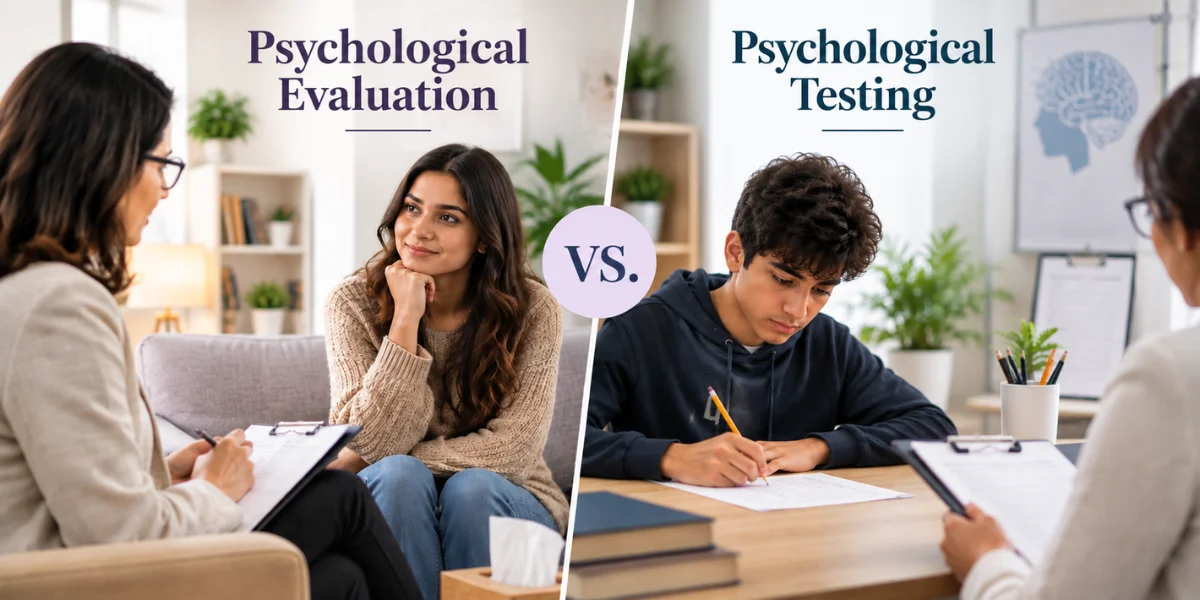
Psychological Evaluation vs. Psychological Testing: What’s the Difference?
The terms “psychological testing” and “psychological evaluation” are sometimes used interchangeably, but they are not exactly the same.
Psychological testing generally refers to standardized instruments used to measure specific psychological or cognitive characteristics.
Psychological evaluation is broader. It can integrate testing with interviews, observations, records, questionnaires, collateral information, and clinical interpretation.
In simple terms:
Testing = individual assessment tools
Evaluation = the broader process of integrating information from multiple sources
This distinction is important because meaningful psychological assessment usually involves more than a single test score.
FAQs: Psychological Evaluation vs. Testing
Is psychological testing part of a psychological evaluation?
Yes. Psychological testing can be one component of a broader psychological evaluation.
Is one psychological test enough for a diagnosis?
Not necessarily. Psychologists consider test results alongside other relevant information and clinical context.
Why are multiple assessment methods used?
Using multiple sources can provide a more complete understanding of an individual’s strengths, difficulties, history, and current functioning.
Does Buxani Counseling Care use standardized assessments?
Buxani Counseling Care states that its evaluation process may include standardized psychological, cognitive, academic, behavioral, or developmental measures depending on the evaluation.
Can a consultation help determine whether testing is needed?
Yes. A clinical consultation can help clarify the concerns and determine what type of evaluation, if any, may be appropriate.
Where Can You Get a Psychological Evaluation in Miami?
If you are searching for psychological evaluation in Miami, choosing the appropriate type of assessment is an important first step.
Buxani Counseling Care provides psychological and psychoeducational evaluations in Miami for children, adolescents, and young adults. Its evaluation services include comprehensive psychoeducational evaluations, ADHD evaluations, specific learning disability evaluations, autism evaluations, gifted evaluations, and emotional and behavioral evaluations.
The clinical team can help families understand which type of evaluation may be appropriate based on the individual’s age, history, concerns, and the questions that need to be answered.
If you are unsure whether an evaluation is appropriate, starting with a consultation can help clarify the next step.
FAQs: Psychological Evaluation in Miami
Where can I get a psychological evaluation in Miami?
Buxani Counseling Care provides psychological and psychoeducational evaluation services in Miami for children, adolescents, and young adults.
Does Buxani Counseling Care offer ADHD evaluations in Miami?
Yes. ADHD evaluations are among the assessment services offered by Buxani Counseling Care.
Can Buxani Counseling Care evaluate learning difficulties?
Yes. Buxani Counseling Care offers specific learning disability evaluations as well as comprehensive psychoeducational evaluations.
Does Buxani Counseling Care evaluate children and adolescents?
Yes. Its psychological and psychoeducational evaluation services are designed for children, adolescents, and young adults.
How do I know which evaluation to choose at Buxani Counseling Care?
The appropriate evaluation depends on the individual’s age, developmental history, current concerns, and the specific questions that need to be answered. A consultation can help identify the appropriate starting point.
Key Takeaway: What Happens During a Psychological Evaluation?
So, what happens during a psychological evaluation?
In most cases, the process involves much more than completing a test. A psychologist may conduct an interview, review relevant history and records, administer standardized assessments, gather questionnaire or rating-scale information, observe behavior, interpret the results, and provide individualized recommendations.
The goal is to develop a clearer understanding of the individual rather than relying on one score or one observation.
For families in Miami seeking greater clarity about learning, attention, developmental, cognitive, emotional, or behavioral concerns, a psychological or psychoeducational evaluation can be an important step toward understanding strengths and identifying appropriate support.
Buxani Counseling Care offers individualized psychological and psychoeducational evaluation services in Miami for children, adolescents, and young adults.
If you are considering an evaluation, a consultation can help you understand what type of assessment may be appropriate and what to expect from the process.
Common FAQs About Psychological Evaluations
What should I expect on the day of a psychological evaluation?
You can expect a combination of conversation, questionnaires, and assessment activities. The exact process depends on the purpose of the evaluation, your age, and the concerns being assessed.
Can a psychological evaluation diagnose mental health conditions?
A psychological evaluation can provide important information that may support or clarify a diagnosis. The psychologist considers test results together with interviews, history, observations, and other relevant information.
Can adults get a psychological evaluation?
Yes. Psychological evaluations can be conducted for adults as well as children and adolescents, depending on the individual’s concerns and the type of assessment needed.
Does Buxani Counseling Care provide psychological evaluations for Miami residents?
Yes. Buxani Counseling Care provides psychological and psychoeducational evaluation services in Miami, including assessments for children, adolescents, and young adults.
Can Buxani Counseling Care help if I am unsure which evaluation I need?
Yes. A consultation with Buxani Counseling Care can help clarify your concerns and determine which type of psychological or psychoeducational evaluation may be appropriate.
Can psychological evaluation results help identify an individual’s strengths?
Yes. Psychological evaluations are not only focused on difficulties. Depending on the assessment, they can identify cognitive, academic, learning, behavioral, developmental, and other areas of strength that can inform individualized recommendations.